The Heartland and Sacred Sites
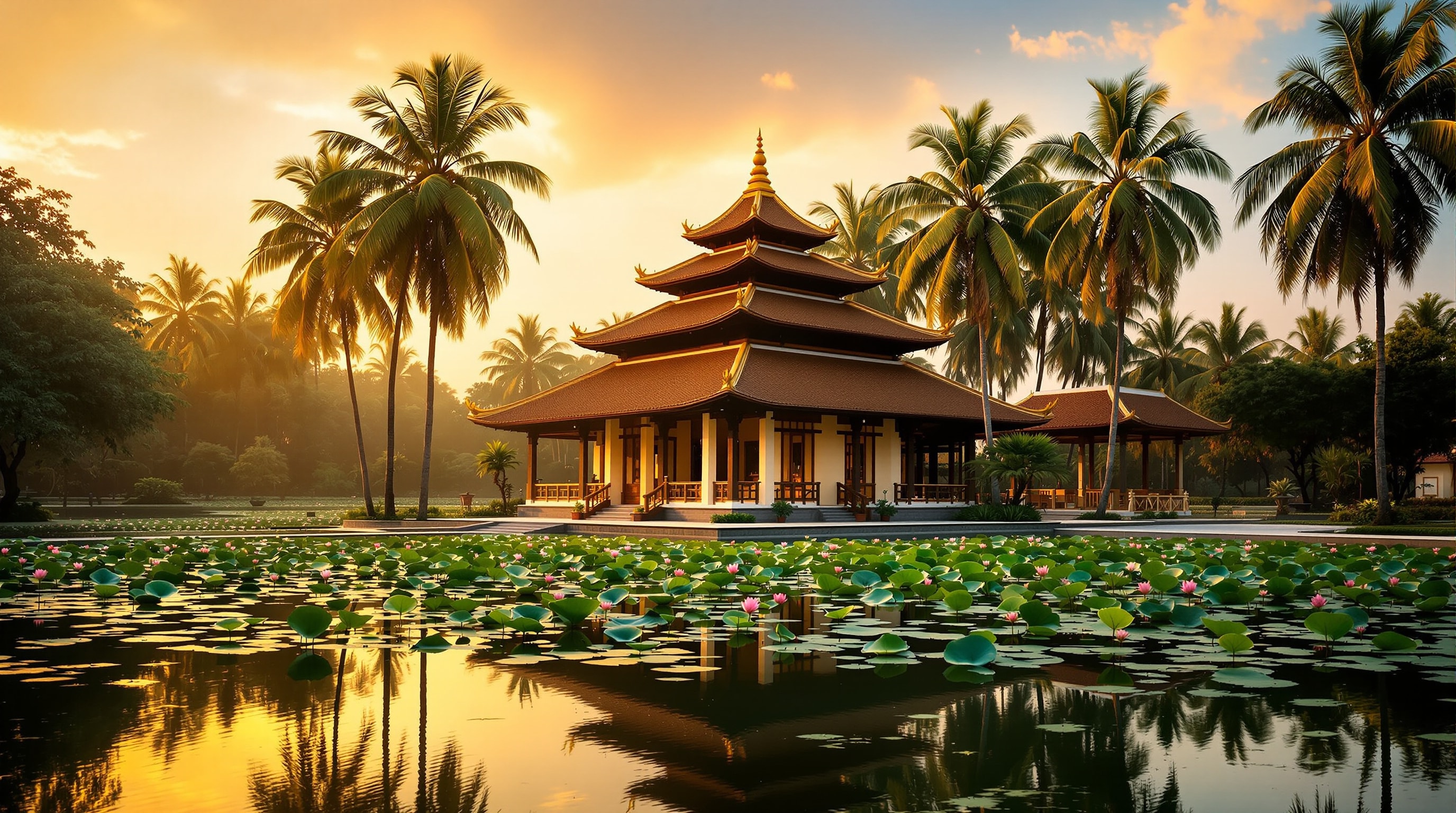
Hòa Hảo Buddhism is rooted in a particular place: the western Mekong Delta of southern Vietnam, and above all the village of Hòa Hảo where the tradition began. Its most significant sites are modest by the standards of grand religious architecture — fittingly, for a tradition that prizes plainness.
The village of Hòa Hảo
The tradition takes its name from Hòa Hảo village, in Tân Châu district of what was Châu Đốc Province and is today An Giang Province, close to the Cambodian border. This is where Huỳnh Phú Sổ was born and began teaching in 1939, and it remains the spiritual centre of the community. Each year the founding anniversary draws very large gatherings of adherents to the village and its surroundings.
An Hòa Tự
The temple most closely associated with the tradition's origins is An Hòa Tự, an established temple in Hòa Hảo village that predates the movement and became bound up with its early history. For adherents it is among the most important places connected with the beginnings of Hòa Hảo Buddhism, and it features prominently in the community's ceremonial life and in its collective memory of the founding period.
The Tổ Đình
The Tổ Đình — literally the "ancestral hall" — refers to the founder's family home and the site associated with his family, honoured as the wellspring of the tradition. In a faith with no elaborate temple hierarchy, this ancestral site carries particular weight as the place where the movement was born. It is a focus of visits and observance, especially around the great anniversaries.
The Mekong Delta heartland
Beyond the founding village, the tradition's true "sacred geography" is the western delta itself. Adherents are concentrated in the provinces of the lower Mekong — An Giang, Đồng Tháp, Cần Thơ, Vĩnh Long, Hậu Giang, Kiên Giang and their neighbours — a landscape of rice fields, rivers, and canals often called the rice bowl of Vietnam. The tradition's history of land reclamation, farming, and charity is inseparable from this fertile, flood-shaped country. The delta is threaded by the many mouths of the Mekong River.
The Thất Sơn (Seven Mountains)
To the west, near the border, rise the Thất Sơn or Seven Mountains — an isolated cluster of hills amid the flat delta that has long held religious significance in the region. It was here that the earlier Bửu Sơn Kỳ Hương reform movement took root, and the tradition connects the founder's period of retreat and awakening with these sacred heights. The mountains remain an evocative part of the tradition's landscape and lore.
The founding anniversary and pilgrimage
The rhythm of the Hòa Hảo year turns on a handful of great anniversaries, above all the founding day on the eighteenth of the fifth lunar month and the commemoration of the founder. On these occasions the tradition's otherwise dispersed, home-based devotion becomes strikingly public: very large numbers of adherents travel to Hòa Hảo village and its temples, and the roads of the western delta fill with pilgrims. These gatherings are among the largest religious assemblies in the region and are the moments when the community most visibly expresses its shared identity. For more on how they fit into present-day observance, see the community today.
A plain sacred landscape
It is worth noting how unassuming these sites are. Hòa Hảo Buddhism did not build a network of monumental temples; its holiness is attached to a home village, an ancestral house, a working temple, and the fields and rivers of the delta. That modesty is entirely in keeping with a tradition that located the sacred in ordinary life and taught that devotion belongs as much in the home as in any shrine.