Symbols and Visual Identity
Hòa Hảo Buddhism expresses itself through a small, coherent set of symbols. Like the tradition itself, they are simple and unassuming — and each carries a clear meaning about harmony, humility, and the inward direction of the spiritual life.
The colour dà
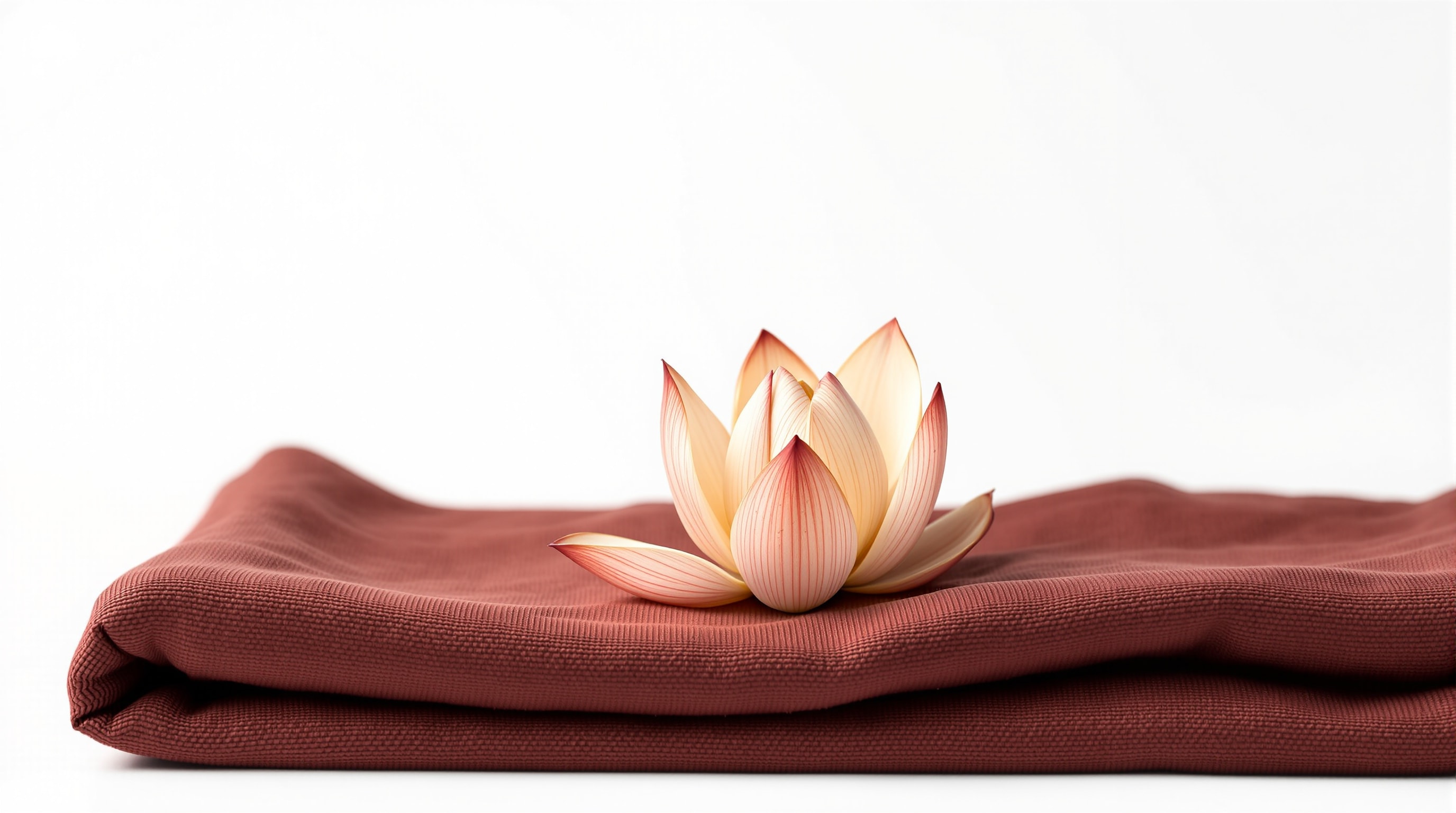
The tradition's most recognisable symbol is a colour: the plain brown or dark maroon known as dà (also nâu sồng). A cloth of this colour is used at the place of worship in the home in place of images, and the colour is closely associated with Hòa Hảo identity generally. The tradition offers a thoughtful rationale for it. Brown is the humble, unshowy colour long worn by religious renunciants, and so it signals simplicity and the renunciation of vanity. Just as importantly, brown is understood as the colour formed when all other colours are blended together — and so it stands for the harmony of all humanity, without distinction of race or station. In a single, modest hue the tradition encodes both its ethic of humility and its ideal of universal concord.
The lotus
As throughout the Buddhist world, the lotus is a central emblem. Rooted in mud yet rising clean and unstained to blossom above the water, the lotus is a natural image of purity emerging from a difficult world — of a person cultivating virtue in the midst of ordinary, imperfect life. That image is especially apt for a tradition that insists the sacred is to be realised at home and in daily work rather than apart from them. Lotus motifs appear widely in the tradition's visual culture.
The emblem and flag
Hòa Hảo Buddhism also has an emblem and a flag in the brown/maroon dà colour, used to mark its ceremonies and gatherings. In keeping with the encyclopaedic aim of this site, they are noted here as a matter of record rather than reproduced as official insignia — this is an independent educational resource, not an official channel of the tradition, and it does not display the community's emblems as though speaking on its behalf. Readers seeking the authentic emblem in its proper ceremonial context should consult the tradition's own community sources.
Incense and clear water
Two humble objects recur so often in Hòa Hảo devotion that they function almost as symbols in their own right: the stick of incense and the glass of clear water. Incense, offered morning and evening, marks the moment of prayer and, in the tradition's own explanation, freshens and consecrates the air. Clear water stands for cleanliness of body and mind — a fitting emblem for a faith that asks above all for an unclouded heart. Together with a few fresh flowers for purity, they make up the entire required offering at the Buddha altar. That so much meaning is carried by so little is precisely the point.
Plainness as a symbol in itself
Perhaps the most telling symbol of Hòa Hảo Buddhism is the absence of elaborate symbols. Where other traditions accumulate statues, relics, and ornament, this one deliberately strips them away, teaching that a clean heart matters more than any outward sign. The bare brown cloth, the single glass of clear water, the plain outdoor incense stand described on the practices page — these speak of a faith that finds meaning in simplicity. The visual restraint is not poverty of imagination but a considered statement of values.